
13a. Regarding Goddess Cultures

Archeologist Marija Gimbutas posits the idea of a Western society before patriarchy, a ‘Goddess Culture’ based on excavations of goddess sculptures unearthed in 1973-1974. As the aesthetic nature of these excavations differed from the works of the Bronze Age, she believed that this culture was distinct from the known Indo-European culture and called this subsect of Southeastern European Neolithic culture ‘Old Europe’ (Murdock 11).
How Can I Get Through to You?: Closing the Intimacy Gap Between Men and Women
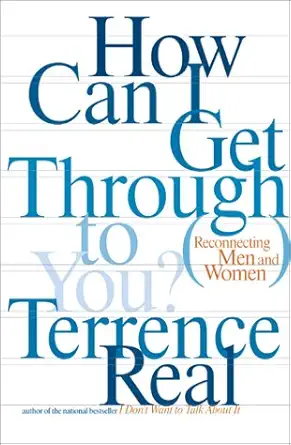
By Terrance Real
Taking a close-up look at gender roles and conditioning, the best-selling author of I Don’t Want to Talk About It explores the current status of intimate relations between men and women and introduces five Core Relationship Skills that couples can use to develop true intimacy. 100,000 first printing.
Men nearly caused human extinction 7,000 years ago, new theory states

Jamie Seidel, 2018
Revisiting the Neolithic Y chromosome bottleneck, this article explores the hypothesis that widespread conflict among male kin groups dramatically reduced male genetic diversity thousands of years ago. It considers how emerging patterns of violence, competition, and social organization may have shaped the development of early human societies.
The End of Patriarchy: Radical Feminism for Men
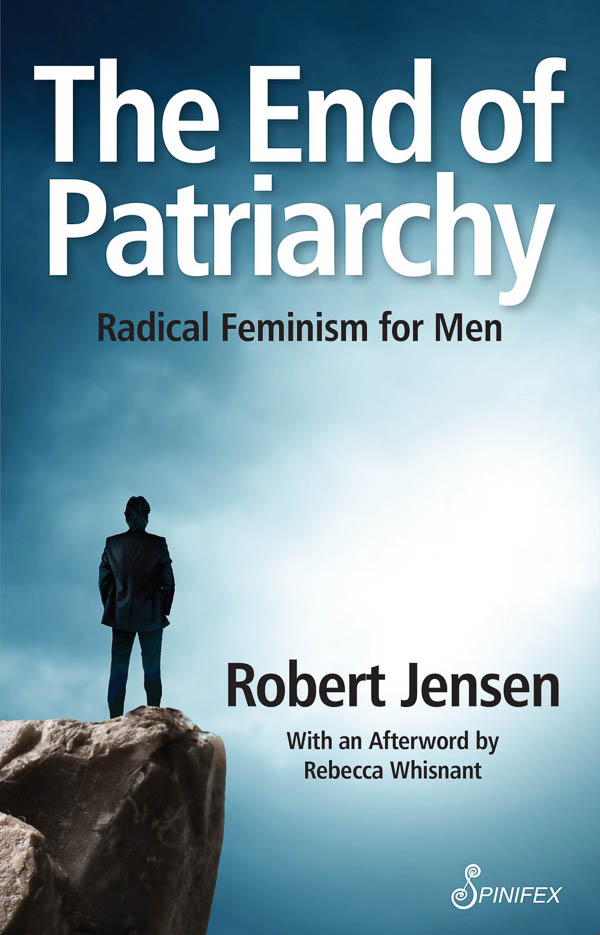
The End of Patriarchy asks one key question: what do we need to create stable and decent human communities that can thrive in a sustainable relationship with the larger living world? Robert Jensen’s answer is feminism and a critique of patriarchy. He calls for a radical feminist challenge to institutionalized male dominance; an uncompromising rejection of men’s assertion of a right to control women’s sexuality; and a demand for an end to the violence and coercion that are at the heart of all systems of domination and subordination. The End of Patriarchy makes a powerful argument that a socially just society requires no less than a radical feminist overhaul of the dominant patriarchal structures.
Social Evolution in Summary with Context

Miki Kashtan, 2019
The underlying principle of patriarchy, as I understand it, is separation and control. The separation is from self, other, life, and nature. The fundamental structures we have created over these millennia are based on dominance and submission, and the worldview we have inherited justifies them as necessary to overcome both our basic nature and “Nature”, seen as separate from us.
We pride self-control and frown on “emotionality”; we operate, organizationally, in command and control forms; we have been treating nature as a thing to exploit, use, subdue, and, most recently, convert to commodities for sale.
Dismantling the Patriarchy Within

Anne Baring and Faranak Mirjalili, 2021
We sat down to speak about the feminine psyche, both individually and collectively, and we also sat down to discuss the challenges that we are facing in this time. If we are to survive as a human species, and most importantly as a whole earth species, we need to come into a better understanding and balance between the feminine and masculine principles. Both these principles need to be equally honored, respected and lived.
But what does this really mean when patriarchy has reigned for more than 4,000 years. How do we know what our feminine qualities are and what does it even mean to be a woman in a time of global climate catastrophe? Are we doing enough as women to stand up against tyrannical political leaders? Is it enough to stand up in protest and even to say no to that which we no longer accept? Are we doing enough to dismantle patriarchy through our outer actions?
The Origins of Fatherhood: An Ancient Family Process
By Sebastian Kraemer
Despite appearances to the contrary (fostered by anthropocentric nursery stories), a distinct role for male parents does not exist in nature. Fatherhood was invented by humans during the agricultural revolution about six thousand years ago. Symbolized by the new god-king, it incorporated the mother’s originally superior role in primate families – the control or ownership of children. The male deity could even make his own offspring without female help.
This inflated political figure was designed to compensate for the male’s modest role in procreation, once the facts of life were known. Patriarchy was born out of an envious attack on mothers.
When God Was A Woman
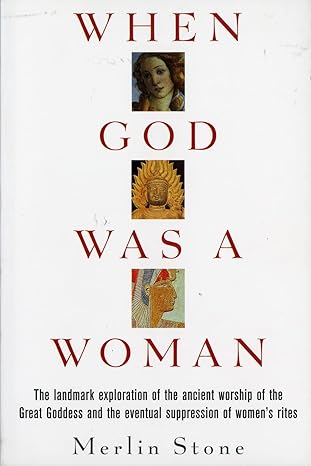
The landmark exploration of the ancient worship of the Great Goddess and the eventual supression of women’s rites.In the beginning, God was a woman…How did the shift from matriarchy to patriarchy come about? In fascinating detail, Merlin Stone tells us the story of the Goddess who reigned supreme in the Near and Middle East. Under her reign, societal roles differed markedly from those in patriarchal Judeo-Christian cultures: women bought and sold property, traded in the marketplace, and inherited title and land from their mothers. Documenting the wholesale rewriting of myth and religious dogmas, Merlin Stone describes an ancient conspiracy in which the Goddess was reimagined as a wanton, depraved figure, a characterization confirmed and perpetuated by one of modern culture’s best-known legends—that of the fall of Adam and Eve. Insightful and thought-provoking, this is essential reading for anyone interested in the origin of current gender roles and in rediscovering women’s power.
The Will To Change: Men, Masculinity and Love
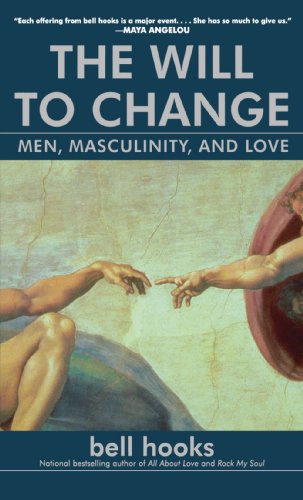
Bell Hooks (born Gloria Jean Watkins) was an African-American author, feminist, and social activist. Her writing focused on the interconnectivity of race, class, and gender and their ability to produce and perpetuate systems of oppression and domination. She published over thirty books and numerous scholarly and mainstream articles, appeared in several documentary films and participated in various public lectures. Primarily through a postmodern female perspective, she addressed race, class, and gender in education, art, history, sexuality, mass media and feminism.
As bell hooks says, “Learning to wear a mask (that word already embedded in the term ‘masculinity’) is the first lesson in patriarchal masculinity that a boy learns. He learns that his core feelings cannot be expressed if they do not conform to the acceptable behaviors sexism defines as male. Asked to give up the true self in order to realize the patriarchal ideal, boys learn self-betrayal early and are rewarded for these acts of soul murder
Nurturing Our Humanity: How Domination and Partnership Shape Our Brains, Lives, and Future
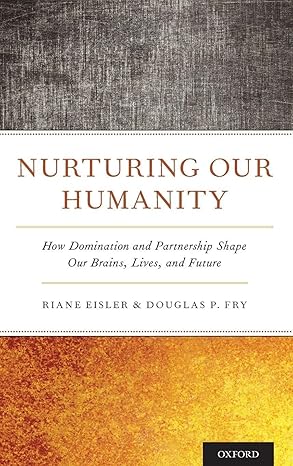
Nurturing Our Humanity offers a new perspective on our personal and social options in today’s world, showing how we can build societies that support our great human capacities for consciousness, caring, and creativity. It brings together findings–largely overlooked–from the natural and social sciences debunking the popular idea that we are hard-wired for selfishness, war, rape, and greed.
Its groundbreaking new approach reveals connections between disturbing trends like climate change denial and regressions to strongman rule. It looks at where societies fall on the partnership-domination scale.
On one end is the domination system that ranks man over man, man over woman, race over race, and man over nature. On the other end is the more peaceful, egalitarian, gender-balanced, and sustainable partnership system.
.
It shows how through today’s ever more fearful, frenzied, and greed-driven technologies of destruction and exploitation, the domination system may lead us to an evolutionary dead end. A more equitable and sustainable way of life is biologically possible and culturally attainable: we can change our course.