
30. “Beyond Trump: The failures that led to the Capitol riots”

An examination of the factors surrounding the January 6, 2021 attack on the U.S. Capitol, looking beyond the actions of Donald Trump to consider the roles of political allies, news and social media, law enforcement, and longer-standing forms of extremism and racial division. The piece presents several perspectives on how these overlapping factors contributed to the events and what they might mean for American democracy.
27a. Age of Aquarius, Summary

A summary of the astrological concept of the Age of Aquarius, tracing the symbolic themes associated with successive astrological ages from Leo through Pisces and into Aquarius. The piece explores ideas of individual consciousness, freedom, technology, collaboration, humanitarianism, and the movement from hierarchical systems toward networks and collective participation.
Memenomics – Spiral Dynamics
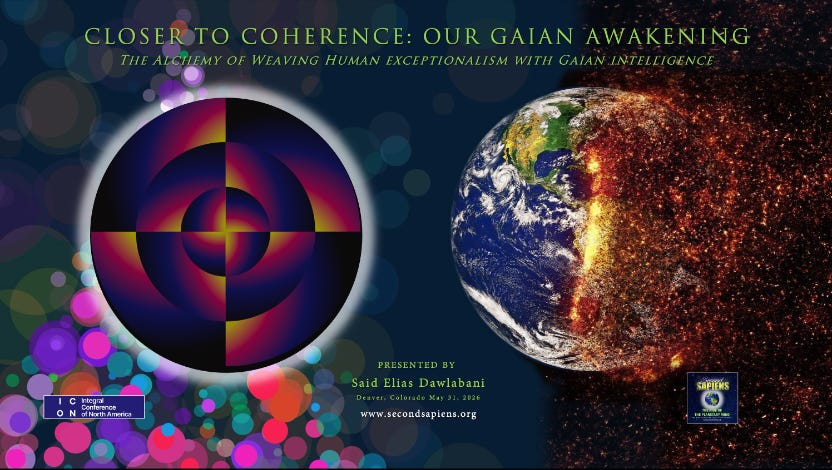
Memenomics explores Spiral Dynamics, systems thinking, integral theory, and models of social and institutional change. The site examines how developmental stages, governance, technology, geopolitics, and changing social systems interact, with a focus on understanding complex societal challenges and transformation.
Astrobutterfly – “Age of Aquarius: The Next Chapter”

As long as the ego is separate from the soul, we won’t have freedom and progress (Aquarius’ higher manifestation) but instead will have division and will continue to attempt to use machines (weapons, robots, or the internet) to justify one side of the story – either “the ego” or “the soul”.
However, sooner or later, at the end of this ‘cosmic battle’, when we’ll reconcile the YING and the YANG, and we will eventually find a “new Renaissance” – or the triumph of Aquarius’ highest values: humanitarianism, knowledge, reason, innovation, and people who work towards a greater goal.
16b. How Do We Change Our Energies?

What does it take to change the way we experience ourselves, one another, and the world around us? Drawing from the work of Dr. Joe Dispenza, MaryCarol R. Hunter and colleagues, Humanity’s Team, and Indra Adnan, this reflection explores consciousness, nervous-system regulation, connection with nature, collaboration, and the possibility of personal and collective transformation.
The World We Have

Thich Nhat Hanh reflects on the environmental crisis as a consequence of collective unconsciousness, urging a way of living rooted in mindfulness, compassion, and reverence for the Earth. Rather than seeking endless consumption, he invites us to awaken to our interdependence and embrace a vision of well-being grounded in simplicity, love, and shared responsibility.
The Uninhabitable Earth
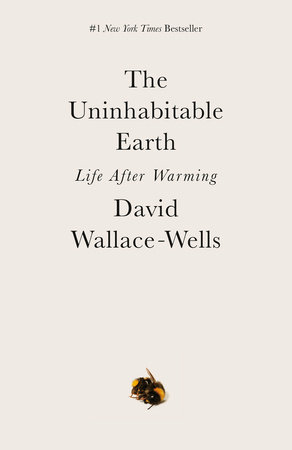
It is worse, much worse, than you think. If your anxiety about global warming is dominated by fears of sea-level rise, you are barely scratching the surface of what terrors are possible—food shortages, refugee emergencies, climate wars and economic devastation.
The Uninhabitable Earth is both a travelogue of the near future and a meditation on how that future will look to those living through it—the ways that warming promises to transform global politics, the meaning of technology and nature in the modern world, the sustainability of capitalism and the trajectory of human progress.
Falter: Has the Human Game Begun to Play Itself Out?
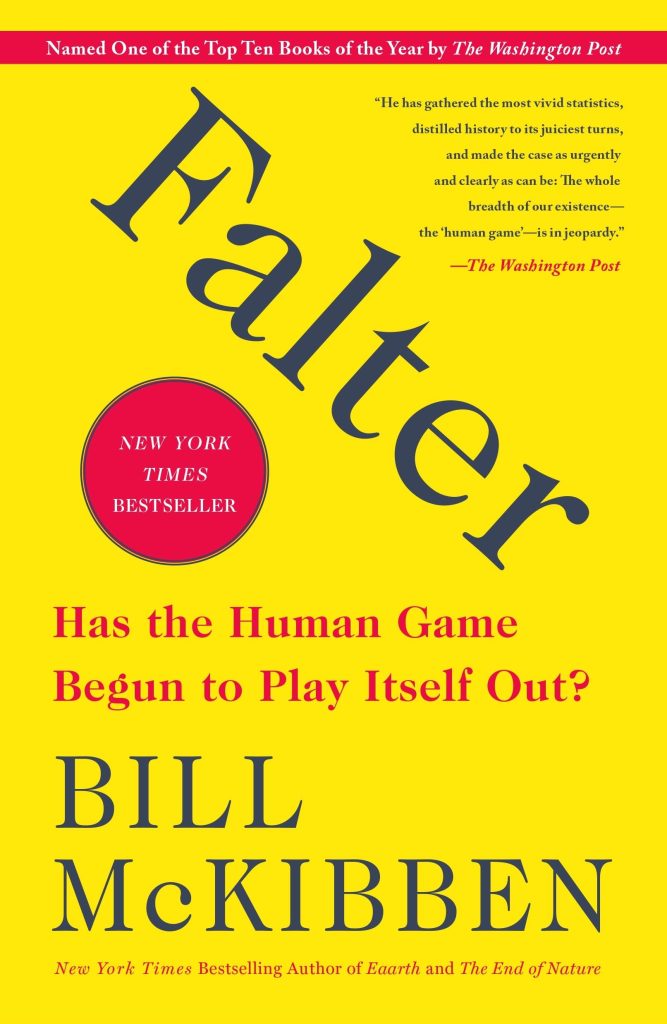
Bill McKibben’s groundbreaking book The End of Nature—issued in dozens of languages and long regarded as a classic—was the first book to alert us to global warming. But the danger is broader than that: even as climate change shrinks the space where our civilization can exist, new technologies like artificial intelligence and robotics threaten to bleach away the variety of human experience.
Falter tells the story of these converging trends and of the ideological fervor that keeps us from bringing them under control. And then, drawing on McKibben’s experience in building 350.org, the first truly global citizens movement to combat climate change, it offers some possible ways out of the trap. We’re at a bleak moment in human history—and we’ll either confront that bleakness or watch the civilization our forebears built slip away.
Nurturing Our Humanity: How Domination and Partnership Shape Our Brains, Lives, and Future
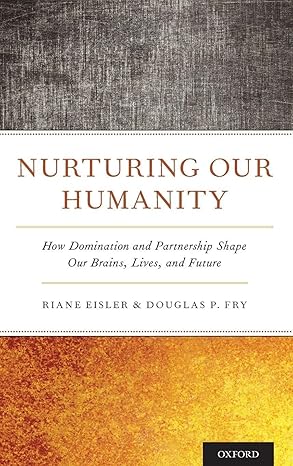
Nurturing Our Humanity offers a new perspective on our personal and social options in today’s world, showing how we can build societies that support our great human capacities for consciousness, caring, and creativity. It brings together findings–largely overlooked–from the natural and social sciences debunking the popular idea that we are hard-wired for selfishness, war, rape, and greed.
Its groundbreaking new approach reveals connections between disturbing trends like climate change denial and regressions to strongman rule. It looks at where societies fall on the partnership-domination scale.
On one end is the domination system that ranks man over man, man over woman, race over race, and man over nature. On the other end is the more peaceful, egalitarian, gender-balanced, and sustainable partnership system.
.
It shows how through today’s ever more fearful, frenzied, and greed-driven technologies of destruction and exploitation, the domination system may lead us to an evolutionary dead end. A more equitable and sustainable way of life is biologically possible and culturally attainable: we can change our course.